Embedding the ALC language
The \(\mathcal{ALC}\) description logic extends \(\mathcal{EL}\) with
negation, disjunction and universal restrictions. mOWL provides
FALCON [falcon2022], a fuzzy-\(\mathcal{ALC}\)
neural reasoner: every class expression is interpreted as a fuzzy set over a
collection of named and sampled anonymous entities, and axioms are scored through
fuzzy logical operators. The training objective combines a TBox term and two ABox
terms (concept and relation assertions), weighted by alpha and beta
(\(\mathcal{L} = \alpha\,\mathcal{L}_T + \beta\,\mathcal{L}_{A_1} +
(1-\alpha-\beta)\,\mathcal{L}_{A_2}\)).
Reproducing the Family experiment
We reproduce Figure 1 of the FALCON paper. We build a small family ontology — a
class hierarchy (SubClassOf), defining intersections (e.g.
Parent ⊓ Male ⊑ Father), disjointness axioms, and one individual asserted per
concept — and train FALCON on it.
from java.util import HashSet
from mowl.datasets import Dataset
from mowl.models import FALCONModel
from mowl.owlapi.adapter import OWLAPIAdapter

adapter = OWLAPIAdapter()
ontology = adapter.create_ontology("http://mowl/family")
cls = lambda name: adapter.create_class("http://" + name)

concepts = ["Male", "Female", "Parent", "Child", "Person",
            "Father", "Mother", "Boy", "Girl", "Grandma"]
c = {name: cls(name) for name in concepts}
axioms = HashSet()

for sub, sup in [("Male", "Person"), ("Female", "Person"), ("Parent", "Person"),
                 ("Child", "Person"), ("Father", "Male"), ("Father", "Parent"),
                 ("Mother", "Female"), ("Mother", "Parent"), ("Boy", "Male"),
                 ("Boy", "Child"), ("Girl", "Female"), ("Girl", "Child"),
                 ("Grandma", "Mother")]:
    axioms.add(adapter.create_subclass_of(c[sub], c[sup]))

for (left, right), target in [(("Parent", "Male"), "Father"),
                              (("Parent", "Female"), "Mother"),
                              (("Child", "Male"), "Boy"),
                              (("Child", "Female"), "Girl")]:
    axioms.add(adapter.create_subclass_of(
        adapter.create_object_intersection_of(c[left], c[right]), c[target]))

for a, b in [("Male", "Female"), ("Parent", "Child"),
             ("Boy", "Girl"), ("Father", "Mother")]:
    axioms.add(adapter.create_disjoint_classes(c[a], c[b]))

for name in concepts:
    individual = adapter.create_individual("http://" + name.lower() + "_0")
    axioms.add(adapter.create_class_assertion(c[name], individual))

adapter.owl_manager.addAxioms(ontology, axioms)
dataset = Dataset(ontology, validation=ontology, testing=ontology)

model = FALCONModel(dataset, embed_dim=50, anon_e=4, alpha=0.5, beta=0.5,
                    learning_rate=0.01, num_negs=8)
model.train(epochs=300, validate_every=100)
The learned fuzzy model can be inspected with
FALCONVisualizer, which computes the
membership degree \(\mu(C, e)\) of every concept C over the named individuals
and a number of sampled anonymous entities, and renders it as a heatmap:
from mowl.visualization import FALCONVisualizer

visualizer = FALCONVisualizer(model)
matrix, concepts, entities = visualizer.membership_matrix(n_anon=2)
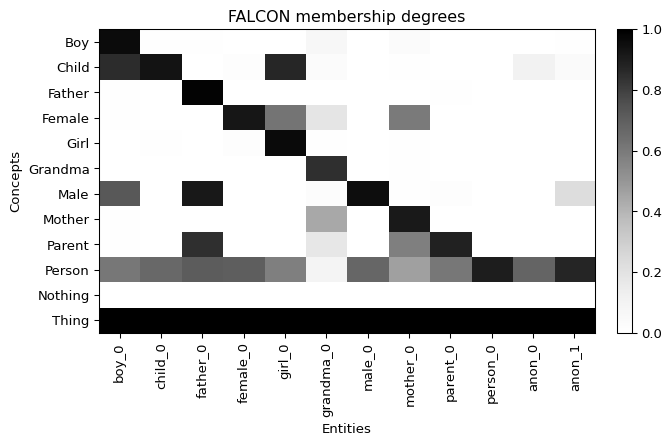
FALCON membership degrees on the Family ontology (dark = membership close to 1).
Each individual is a member of its asserted concept and of every super-concept
entailed by the TBox — for example, boy_0 belongs to Boy, Child,
Male and Person — while Nothing is empty and Thing is universal.
You can also access the learned embeddings:
class_embeddings = model.class_embeddings
object_property_embeddings = model.object_property_embeddings