Note
Go to the end to download the full example code.
Geometric EL Embeddings: Training Animation
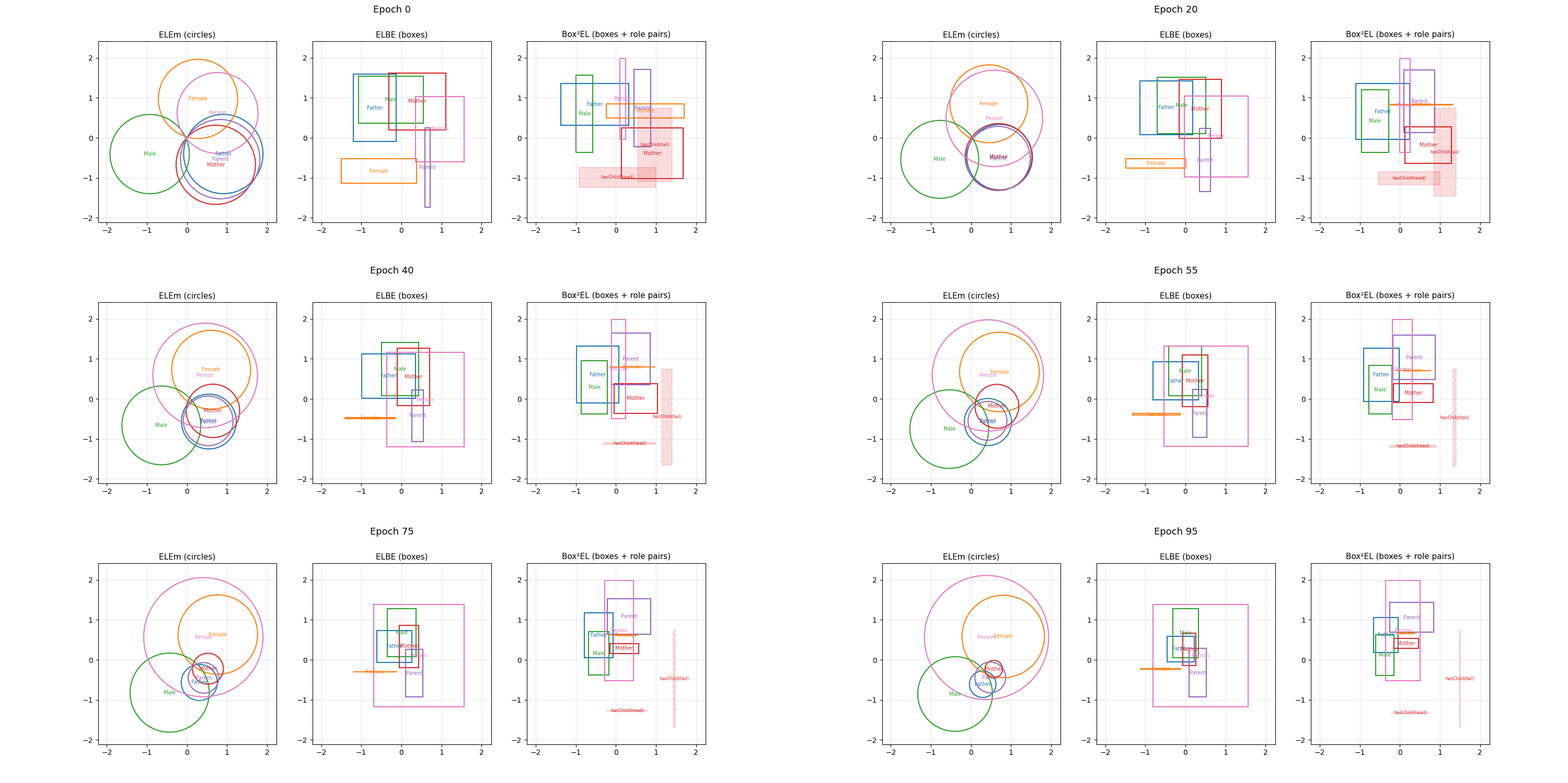
All three geometric EL models embed ontology classes as 2-D shapes when
trained with embed_dim=2, letting us watch the geometry evolve directly —
no dimensionality reduction needed.
ELEm — classes as circles (centre
class_embed, radiusclass_rad)ELBE — classes as axis-aligned rectangles (centre
class_embed, half-extentsclass_offset)Box²EL — classes as axis-aligned rectangles (centre
class_center, half-extentsclass_offset); roles as pairs of boxes — head box (solid, soft fill) and tail box (dashed, soft fill)
This example trains all three models on the Family ontology and produces an interactive animation showing how the shapes evolve across epochs.
Imports and JVM initialisation
import mowl
mowl.init_jvm("10g")

import matplotlib
matplotlib.use("Agg")
import matplotlib.pyplot as plt
import matplotlib.patches as mpatches
import matplotlib.animation as animation
import numpy as np
import torch as th
from IPython.display import HTML

from mowl.datasets.builtin import FamilyDataset
from mowl.models import ELEmbeddings, ELBE, BoxSquaredEL
from mowl.visualization.el.base import _local_name
Dataset and entity selection
dataset = FamilyDataset()
Training parameters
EPOCHS = 100
SNAPSHOT_EVERY = 5
N_CLASSES = 6
Snapshot helpers
We store raw numpy arrays per snapshot and recreate patches at animation time.
def _indices(model, n):
    items = list(model.class_index_dict.items())[:n]
    iris = [iri for iri, _ in items]
    idxs = th.tensor([idx for _, idx in items])
    return iris, idxs


def _role_indices(model):
    items = list(model.object_property_index_dict.items())
    iris = [iri for iri, _ in items]
    idxs = th.tensor([idx for _, idx in items])
    return iris, idxs


def _elem_snapshot(model, idxs):
    with th.no_grad():
        centers = model.module.class_embed.weight[idxs].cpu().numpy()
        radii   = np.abs(model.module.class_rad.weight[idxs].cpu().numpy())
    return centers, radii


def _box_snapshot_elbe(model, idxs):
    with th.no_grad():
        centers = model.module.class_embed.weight[idxs].cpu().numpy()
        halves  = np.abs(model.module.class_offset.weight[idxs].cpu().numpy())
    return centers, halves


def _box_snapshot_box2(model, class_idxs, role_idxs):
    with th.no_grad():
        centers    = model.module.class_center.weight[class_idxs].cpu().numpy()
        halves     = np.abs(model.module.class_offset.weight[class_idxs].cpu().numpy())
        head_cs    = model.module.head_center.weight[role_idxs].cpu().numpy()
        head_hs    = np.abs(model.module.head_offset.weight[role_idxs].cpu().numpy())
        tail_cs    = model.module.tail_center.weight[role_idxs].cpu().numpy()
        tail_hs    = np.abs(model.module.tail_offset.weight[role_idxs].cpu().numpy())
    return centers, halves, head_cs, head_hs, tail_cs, tail_hs


def make_callback(snapshots, getter, *getter_args):
    def callback(epoch, model):
        if epoch % SNAPSHOT_EVERY == 0:
            snapshots.append(getter(model, *getter_args))
    return callback
Train ELEm
elem_model = ELEmbeddings(dataset, embed_dim=2, learning_rate=0.01, margin=-0.1)
iris, idxs = _indices(elem_model, N_CLASSES)
labels = [_local_name(iri) for iri in iris]

elem_snapshots = []
elem_model.train(epochs=EPOCHS,
                 epoch_callback=make_callback(elem_snapshots, _elem_snapshot, idxs))
Train ELBE
elbe_model = ELBE(dataset, embed_dim=2, learning_rate=0.01, margin=-0.1)
elbe_snapshots = []
elbe_model.train(epochs=EPOCHS,
                 epoch_callback=make_callback(elbe_snapshots, _box_snapshot_elbe, idxs))
Train Box²EL
box2_model = BoxSquaredEL(dataset, embed_dim=2, learning_rate=0.01, margin=-0.1)
role_iris, role_idxs = _role_indices(box2_model)
role_labels = [_local_name(iri) for iri in role_iris]

box2_snapshots = []
box2_model.train(epochs=EPOCHS,
                 epoch_callback=make_callback(box2_snapshots, _box_snapshot_box2, idxs, role_idxs))
Build and display the animation
colors = plt.cm.tab10(np.linspace(0, 0.6, N_CLASSES))
role_colors = plt.cm.Set1(np.linspace(0, 0.5, max(1, len(role_iris))))


def _axis_limits(all_snaps, pad=0.3):
    """Compute unified axis limits across all models and all snapshots."""
    xs, ys = [], []
    for snaps in all_snaps:
        for snap in snaps:
            centers, sizes = snap[0], snap[1]
            if sizes.shape[1] == 1:
                r = sizes[:, 0]
                xs.extend((centers[:, 0] - r).tolist())
                xs.extend((centers[:, 0] + r).tolist())
                ys.extend((centers[:, 1] - r).tolist())
                ys.extend((centers[:, 1] + r).tolist())
            else:
                xs.extend((centers[:, 0] - sizes[:, 0]).tolist())
                xs.extend((centers[:, 0] + sizes[:, 0]).tolist())
                ys.extend((centers[:, 1] - sizes[:, 1]).tolist())
                ys.extend((centers[:, 1] + sizes[:, 1]).tolist())
            # Box²EL snaps carry role box extents in positions 2-5
            if len(snap) == 6:
                head_cs, head_hs, tail_cs, tail_hs = snap[2], snap[3], snap[4], snap[5]
                for cs, hs in [(head_cs, head_hs), (tail_cs, tail_hs)]:
                    xs.extend((cs[:, 0] - hs[:, 0]).tolist())
                    xs.extend((cs[:, 0] + hs[:, 0]).tolist())
                    ys.extend((cs[:, 1] - hs[:, 1]).tolist())
                    ys.extend((cs[:, 1] + hs[:, 1]).tolist())
    return min(xs) - pad, max(xs) + pad, min(ys) - pad, max(ys) + pad


xmin, xmax, ymin, ymax = _axis_limits([elem_snapshots, elbe_snapshots, box2_snapshots])

fig, axes = plt.subplots(1, 3, figsize=(15, 5))
model_titles = ["ELEm (circles)", "ELBE (boxes)", "Box²EL (boxes + role pairs)"]
all_snaps = [elem_snapshots, elbe_snapshots, box2_snapshots]


def draw_frame(frame_idx):
    for ax, snaps, title in zip(axes, all_snaps, model_titles):
        ax.cla()
        ax.set_title(title, fontsize=11)
        ax.set_xlim(xmin, xmax)
        ax.set_ylim(ymin, ymax)
        ax.set_aspect("equal")
        ax.grid(True, alpha=0.3)

        snap = snaps[frame_idx]
        centers, sizes = snap[0], snap[1]

        # Draw class shapes
        for i, (cx, cy) in enumerate(centers):
            color = colors[i]
            if sizes.shape[1] == 1:
                r = float(sizes[i, 0])
                patch = mpatches.Circle((cx, cy), r, fill=False,
                                        edgecolor=color, linewidth=1.5)
            else:
                hx, hy = float(sizes[i, 0]), float(sizes[i, 1])
                patch = mpatches.Rectangle(
                    (cx - hx, cy - hy), 2 * hx, 2 * hy,
                    fill=False, edgecolor=color, linewidth=1.5)
            ax.add_patch(patch)
            ax.annotate(labels[i], (cx, cy), ha="center", va="center",
                        fontsize=7, color=color)

        # Draw role boxes for Box²EL: head=solid soft fill, tail=dashed soft fill
        if len(snap) == 6:
            head_cs, head_hs, tail_cs, tail_hs = snap[2], snap[3], snap[4], snap[5]
            for j, rl in enumerate(role_labels):
                rc = role_colors[j]

                hcx, hcy = float(head_cs[j, 0]), float(head_cs[j, 1])
                hhx, hhy = float(head_hs[j, 0]), float(head_hs[j, 1])
                ax.add_patch(mpatches.Rectangle(
                    (hcx - hhx, hcy - hhy), 2 * hhx, 2 * hhy,
                    fill=True, facecolor=rc, alpha=0.15,
                    edgecolor=rc, linestyle="solid", linewidth=1.5))
                ax.annotate(f"{rl}(head)", (hcx, hcy), ha="center", va="center",
                            fontsize=6, color=rc)

                tcx, tcy = float(tail_cs[j, 0]), float(tail_cs[j, 1])
                thx, thy = float(tail_hs[j, 0]), float(tail_hs[j, 1])
                ax.add_patch(mpatches.Rectangle(
                    (tcx - thx, tcy - thy), 2 * thx, 2 * thy,
                    fill=True, facecolor=rc, alpha=0.15,
                    edgecolor=rc, linestyle="dashed", linewidth=1.5))
                ax.annotate(f"{rl}(tail)", (tcx, tcy), ha="center", va="center",
                            fontsize=6, color=rc)

    fig.suptitle(f"Epoch {frame_idx * SNAPSHOT_EVERY}", fontsize=13)


n_frames = len(elem_snapshots)
ani = animation.FuncAnimation(fig, draw_frame, frames=n_frames, interval=150)
Save as an animated GIF that autoplays in browsers and docs pages. When run as a standalone script, the GIF is saved next to the docs images. In a Sphinx Gallery build the file is pre-committed; __file__ is not available.
try:
    import os as _os
    _gif_path = _os.path.join(
        _os.path.dirname(_os.path.abspath(__file__)),
        "../../docs/source/examples/elmodels/images/el_geometry_training.gif"
    )
    ani.save(_gif_path, writer="pillow", fps=6)
except NameError:
    pass
Estimated memory usage: 0 MB